

Floor Pans: The Ultimate FAQ

Starting with the basics, floor troughs are a vital tool for keeping liquids in check & ensuring safety in the area. However, if you need something on a larger scale, floor troughs might take the backseat to comprehensive floor pans instead. Why is this so?
In this article, we’ll answer the most asked questions about floor pans including their advantages, major uses & styles. Let’s begin.
1. What Do I Need One For?
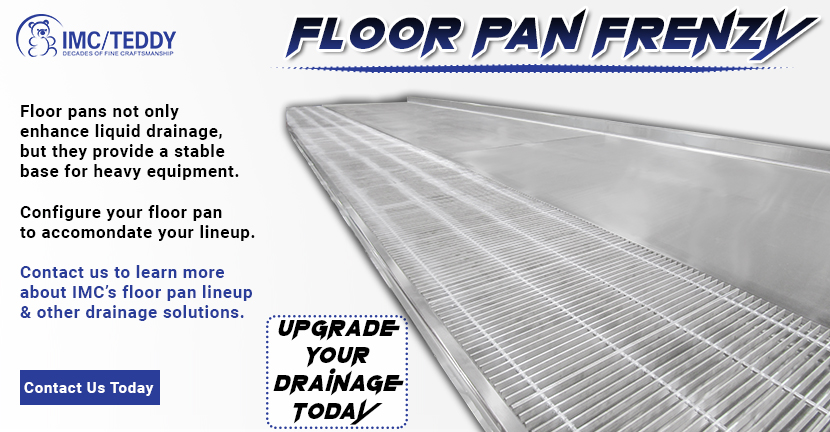
Let’s quickly define what a floor pan is. Floor pans are designed to provide a stable base for heavy equipment while providing liquid drainage. They are designed to protect your floor from corrosion as well.
If you are operating in an environment where there is a lot of cooking equipment & water, a floor pan is a smart choice to safeguard your floor. In the simplest terms, the floor pan is your floor & saves you from having to replace tiles in the future.
2. What are the Best Areas to Install One?
These units are mainly used for institutional & public buildings in large cook-chill facilities. They can also be used to place kettles on, or they can be used for ice machines. Basically, any piece of equipment that sees a large discharge of liquids pairs well with any floor pan to prevent damage to the underlying areas.
They can be used on upper floors or even basements – there is no restrictions on the installation location.
3. How Should I Configure Mine?
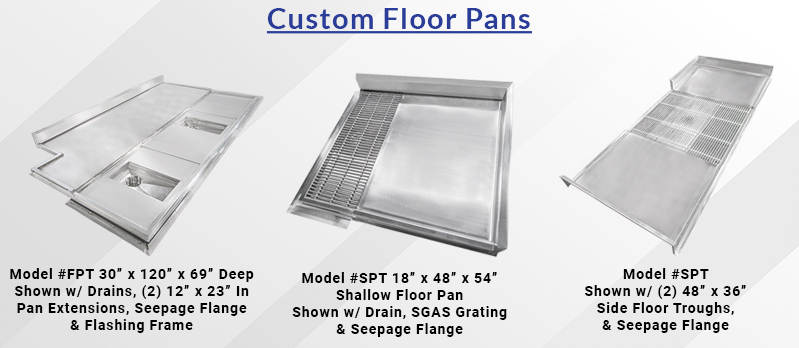
The depth of the floor pan can be configured from 2”, 4” & 6” depending on the expected liquid volume. As far as the pan itself is concerned, the design will come down to your preference & application, but some of the most popular options are as follows:
a. Plinth Blocks – used for locking equipment in place. The number of plinths will depend on how much equipment will be laid on top of the pan.
b. Correctional Package – to make the floor pan tamper proof & compliant for correctional facilities. More on correctional/security equipment can be found here.
c. Seepage Flange – for added leak prevention, useful if the floor pan is used on upper floors of a building. More on seepage flanges can be found here.
d. Extensions – can be inside, on the sides, or outside the floor pan. Used to cover additional area & increase drainage coverage.
Here’s a look at some tailored IMC floor pans to give you a better idea on customization:
4. Are They a Replacement for Floor Troughs?
In a word, no. Floor pans are meant to be paired with heavy commercial equipment & should be seen as an aid, not a replacement. Furthermore, floor troughs are still useful in those tough areas where drainage can be a challenge as well.
At first glance, a floor pan might be like a souped-up floor trough, but the flat area attached to the drain portion is essential for your heavy equipment that constantly expels water & other liquids.
IMC/Teddy manufactures a wide array of floor pans to accommodate your lineup. A variety of troughs, grating, & pan options are available to choose from based on your application. IMC floor pans are also NSF certified & made 100% in the USA. Check out our handy floor pan trifold flyer, which covers the basics of the pans & their primary use.