



How To Tell If Your Product is REALLY Type 300 Series Stainless Steel
In the foodservice industry realm, 3 diverse types of series are used for stainless steel: 200, 300 & 400. Of the three, Type 300 series is the ultimate king of the foodservice market thanks to its corrosion resistant properties among other distinctions (more on these in a bit).
However, it’s quite challenging to differentiate Type 300 with the other two series, which can present a problem when reviewing your purchased products. After all, Type 200 & 400 are quite inferior to Type 300. Is there a checklist of things you should look for to tell if your product is genuinely 300 series stainless steel?
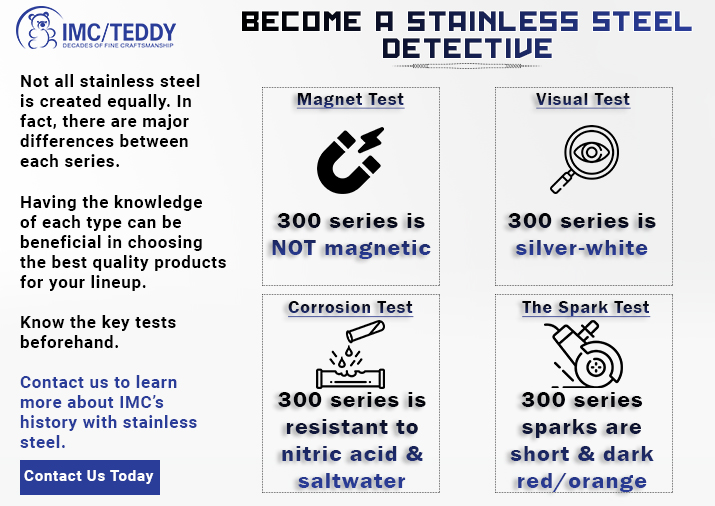
In this article, we will show you 4 reliable methods to tell if your product is, in fact, Type 300 series stainless steel. We’ll also give you our reasoning why we choose to use this series in every single one of our products. Let’s go through the list.
1. The Magnet Test
This is the easiest method & most obvious way to see if your product is 300 Series. Simply place a magnet over the item. If the magnet does not stick (or has a very faint attraction), it is 300 series. The reason for this is because 300 series is austenitic while other series such as 400 are magnetic (ferritic & martensitic).
2. Visual Test
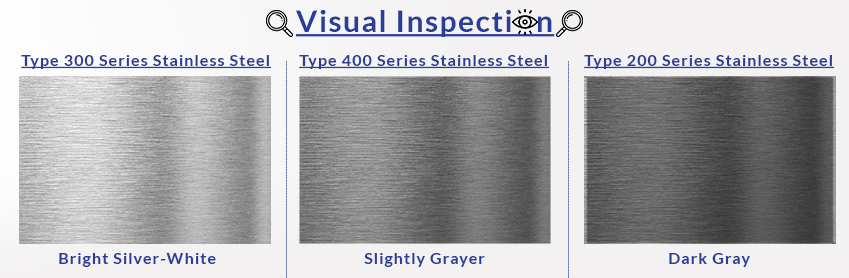
Yes, it is possible to spot 300 series by visual inspection, but you’ll need a trained eye. 300 series is typically a bright, silver-white color with a finished surface. 400 series is typically more on the gray side, while 200 series is a much darker gray. While not the most reliable method, if you have products of a different series side by side, you’ll become an expert in no time. Here’s a little visual guide:
3. Corrosion Test
The longest & most complex method involves evaluating the metal for any signs of corrosion. The most comprehensive way of doing this is to completely douse the product in salt water & leave it in warm place for approximately 24 hours. After about a day, if the product shows no sign of rust, it is 300 series.
Other smaller scale tests such as the nitric acid test exist. This involves doing a spot test on the steel using a high concentration of nitric acid. If the product is 300 series, it should have no reaction. Other series will react quickly producing a brown, strong fume & surface erosion. Here’s a short clip demonstrating the reaction in real time.
4. The Spark Test
Finally, a more hands-on method. The spark test requires the use of a grinder, so you’ll need extra equipment for this method. Take the grinder and use it on a small, inconspicuous spot. If the product is 300 series, the sparks will be small, short, & dark red/orange. If the sparks are long, bright & forked, it is not 300 series. Check out this video of a spark test being performed on stainless steel.
Why Do We Use 300 Series?
IMC/Teddy uses only Type 300 series stainless steel – particularly the 304 & 316 alloys. We believe the balance of performance & versatility far outweighs the other types of stainless steel. It is the most accepted metal in the industry today & brings endless amounts of benefits to the end user.
With many products NSF approved, IMC is committed to manufacturing the highest quality items in the food service industry. To learn more about how IMC can cater to your stainless steel needs, click here.