The Truth About Galvanized Steel (& Why IMC/Teddy Avoids It)
Not all steel is the same. This is especially true if you compare galvanized steel to traditional stainless steel. The fact is one is vastly superior to the other & we’re here to point out the facts about galvanized steel & what this means for finished products. Also, what role does it play in the food service industry? Let’s shine a light on the situation.
In this article, we’ll go over 4 facts about galvanized steel & then we’ll bring it all together for what this means for you. We’ll also go into our reasoning why we avoid it all together & instead opt for stainless steel in our manufacturing. Let’s begin with fact #1.
Fact #1: Galvanized Steel Gets Damaged…Too Easily
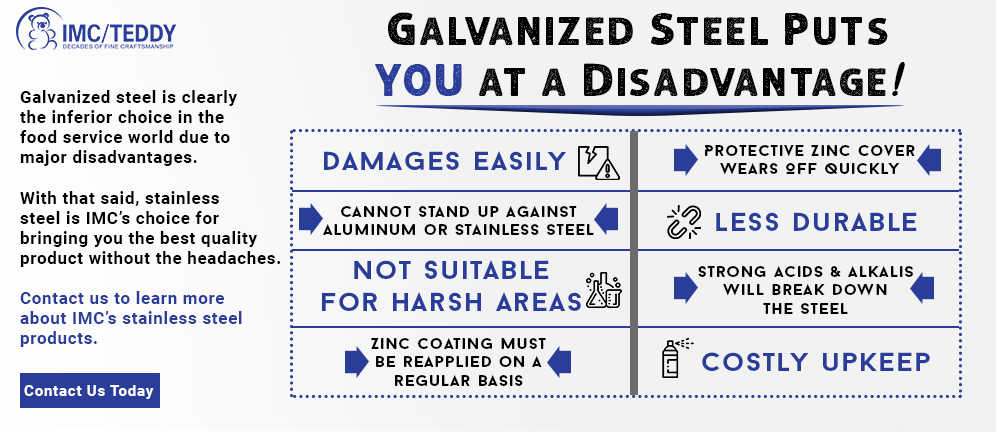
You might think with steel in the name that galvanized steel might be one of the most durable materials, but the fact is it’s prone to major damage.
Only a thin layer of zinc coating is applied to carbon steel, which turns it into the galvanized state. Once this layer is worn away, the steel can get scratched or cut leading to significant breakdown. Without the protective layer of zinc, the steel is also vulnerable to moisture & oxygen, which causes rust to form.
Fact #2: It’s Not as Durable as Stainless Steel
Galvanized steel is much more durable than standard steel or aluminum. However, stainless steel beats it out convincingly.
The overall lifespan of galvanized steel is severely short when compared to stainless steel. This is because the inner carbon steel is softer & weaker than any stainless steel grade.
Fact #3: It Is Bad in Harsh Environments
Galvanized steel WILL fail quickly in salty & marine environments. It will also degrade heavily in any humid or moist conditions. In areas of extreme heat, the zinc will begin to release toxic fumes as well. Compare this is stainless steel, where it can withstand these challenging environments.
Furthermore, galvanized steel is a poor choice in areas where chemicals such as strong acids or alkalis are present. These dissolve the protective zinc coating in no time, leaving the steel open for damage.
Fact #4: The Upkeep Can Be Cumbersome
Apart from routine maintenance such as cleaning, galvanized steel requires the protective coating of zinc to be replaced once it is faded. The time in between recoatings vary & can become difficult to track/predict. The recoating requires a cold galvanizing spray & you’ll need to spray the entire product down, which can be costly.
Why IMC Avoids It
With all the above said, it’s clear that we do not incorporate galvanized steel into our manufacturing. IMC instead chooses Type 304 stainless steel, which provides better strength, lifespan & rust protection. For the food service industry, these 3 aspects are paramount. All stainless steel products are also made in the USA with human hands, so quality control is of the utmost importance as well.
IMC stands by our end results & does not cut corners when it comes to giving you a product that you can display & use proudly in your lineup. For IMC’s full range of stainless steel products, click here.