



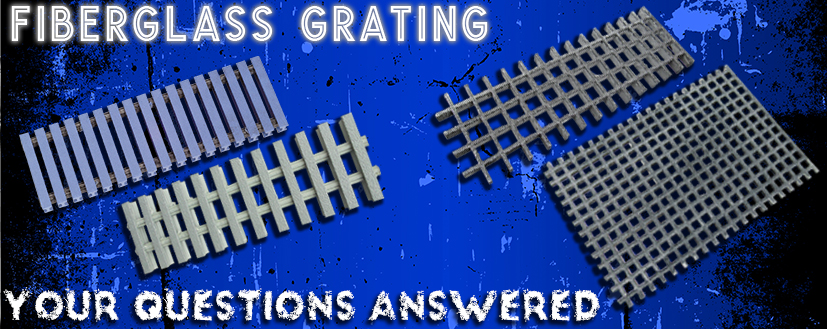
Fiberglass Grating – Your Questions Answered
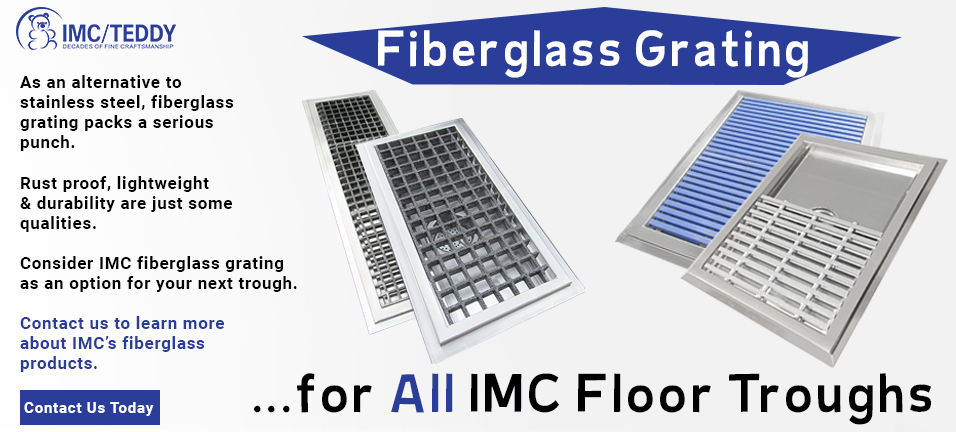
Grating & floor troughs go hand in hand, but not all grating is the same. In fact, grating can vary in materials – this is where fiberglass grating plays a role. However, what is the reason for picking fiberglass grating over traditional stainless steel & what are the real advantages? On top of that, the biggest question of all – is fiberglass grating worth the investment? IMC has the answers.
In this article, we’ll go over 5 common questions about fiberglass grating & give you a better understanding about the material & its best uses. We’ll also go over some IMC fiberglass grating options for you to explore. Let’s begin with the most fundamental question.
1. What Is Fiberglass Grating?
Fiberglass grating is composed of glass fibers & a resin matrix. It’s the ultimate alternative to stainless steel grating. Fiberglass grating is rustproof as well as slip-resistant & lightweight. It combines corrosion resistance with strength for use in unforgiving environments.
Fiberglass grating can also withstand very heavy loads & can be reinforced through bonding, if necessary. Fiberglass is also nonconductive, making it a good fit for environments with little or heavy electricity.
Pultruded fiberglass grating, in particular, is made by pulling fibers through heat, which provide extra stiffness.
2. Ok, But is Stainless Steel Better?
The answer will involve comparing the two & seeing which is a best fit for you (& your project). Let’s start with a simple breakdown:
Stainless Steel Grating
- Non-corrosive – better fit for toxic environments
- Works better in moist/wet environments
- Overall better resistance & durability
- If you are commonly using vehicles, stainless steel grating will work better in the long term
Fiberglass Grating
- Rust proof, slip-resistant & lightweight
- Non-conductive – better fit for electrical or non-electrical environments
- Lightweight for easy removal/cleaning
- Budget friendly
Ultimately, the choice of which material to use will be up to you. However, the question of application and maintenance/upfront costs may sway your decision.
3. Molded Grating vs. Pultruded Fiberglass? What is the Difference?
Both have similar advantages, but strength will vary between the two. Molded grating provides equal, two-way strength while pultruded fiberglass provides higher stiffness & a longer span capacity in one direction. Molded grating is better for walkways or platforms while pultruded grating is suitable for heavy traffic & industrial areas.
IMC offers both varieties: Model #CH is the molded variant, while Model #PFG is the pultruded type. Both are available for any IMC floor trough so the choice will come down to which grating will suit your application.
4. Are There Custom Shapes Available?
Yes, IMC grating can be shaped in nearly any design with custom sizes as well. It should be noted that standard grating is sized up to 20″ long sections, so multiple pieces of grating will be needed if you have a larger sized trough. Typically, IMC grating can exceed 10′ long & 30″ wide (in sections) if you need to cover a wide area.
Along with shapes, fiberglass grating can also be a different color. Yellow is a common color for molded types (Model #CH). We reserve blue for ADA compliant fiberglass grating.
5. About ADA Compliance – Does Fiberglass Grating Meet the Standards?
Yes, in the following ways:
- Pultruded fiberglass grating has grating bar sizes at 0.4” apart (0.9” is the standard)
- Molded fiberglass consists of a 3⁄4” square mesh opening on the top & an 11⁄2” square mesh opening on the bottom. Panels have a 1⁄2” open area between bearing bars.
With these alterations, both gratings are handicap accessible & meet ADA compliance.
Now that you are a fiberglass guru, selecting the right grating for your trough should be a simple task. IMC cuts & customizes each fiberglass grating in house, so we always keep a close eye on your project. Check out some of our other grating products here.