



Let’s Talk About “Marine Grade” Stainless Steel
Stainless steel is made up of many alloys & grades, each with their own unique properties & real world uses. Truth be known, the make-up of the stainless steel will really determine what environment it is best used for. Coastal, or marine, areas are considered a volatile environment for most metals thanks to the salt-laced air. How does this fare for stainless steel?
In this article, we’ll give you the definition of “marine grade” stainless steel & give you some tips to keep your equipment from succumbing to the elements. Let’s break it down.
The Environment
It should come as no surprise that salt water is extremely damaging to any metal. This is because salt is an electrolyte that speeds up corrosion & this leads to eventual pitting & staining.
In fact, salt is so damaging to metal that corrosion can occur within hours to days with visible rust occurring. Over several weeks, metal will begin to show signs of breakdown & severe damage that compromises the integrity of the metal itself.
With that said, coastal areas are one of the most hostile environments for metal & you’ll need specialized equipment to counteract this.
The Equipment
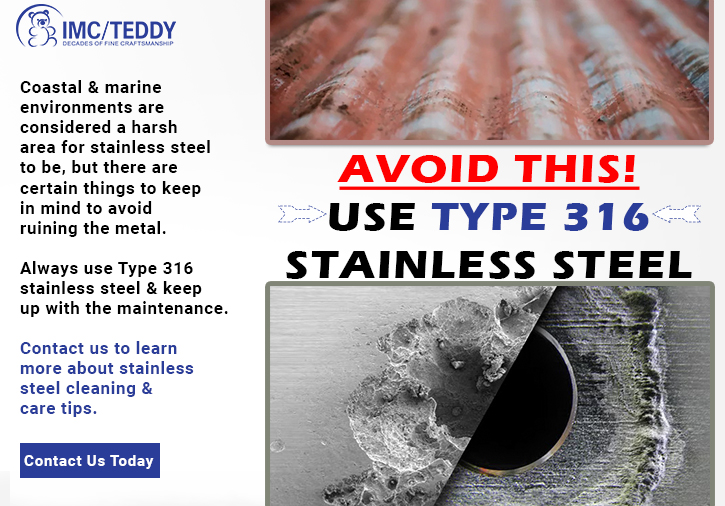
For stainless steel, there is a specific grade & alloy that must be used to combat coastal/marine environments that are filled with salt-laced air. That is Type 316 Stainless Steel. This is the “marine grade” stainless steel.
Type 316 stainless steel contains 16-18% chromium, 10-14% nickel & 2%-3% molybdenum. The molybdenum is the element which gives the metal the ability to resist the salty environment. It is also recommended to mirror polish the stainless steel to reduce areas where the salt can stick to.
The Maintenance
The cardinal rule of maintaining stainless steel near coastal areas is to get into the habit of regularly washing the metal with fresh water to remove any accumulated salt. This means focusing on every crevice & joint. This is especially important after those stormy or high wind days where salt will land on every piece of equipment.
On top of that, apply a protective wax or polish every month to eliminate the risk of corrosion.
Remember – no abrasive cleaners like bleach or wool pads! Use a microfiber cleaning cloth to avoid damaging the surface of the metal. Always wipe with the grain.
Coastal/marine areas are just one type of environment that can be a challenge for stainless steel. Knowing to select the correct stainless steel & staying ahead of the maintenance are imperative. With these tips in mind, you should be ready to tackle any challenge. For more stainless steel maintenance tips & tricks, click here.