



Flanged Feet vs. Bullet Feet: The Showdown

Stainless steel products such as worktables, shelving & cabinets must always remain level with the ground, so the products do not wobble or, in the worst case, tip over. With that said, leveling legs are used to complete the balancing act.
In the world of stainless steel, two types of legs exist: flanged feet & bullet feet. Both have the same goal, but they vary quite differently in function & execution. What is the difference between them & which is better for you? IMC is here to answer these questions.
In this article, we will pit flanged feet vs. bullet feet in a showdown to determine which has the upper hand. We’ll also go over IMC products that offer both types of legs. Let the match begin.
Flanged Feet – The Stable Option
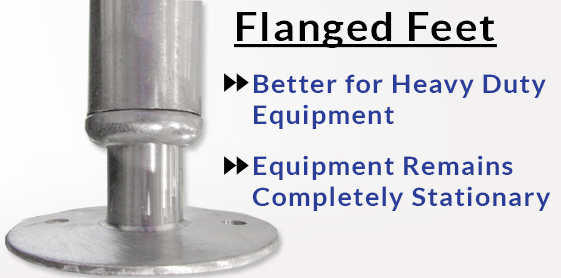
Flanged feet (also called seismic feet) can be described as a flat disc at the base of the foot with pre-drilled bolt holes. It is specifically designed to keep equipment permanently in place. Therefore, it is useful for heavy duty equipment or equipment found in correctional facilities where no loose parts are permitted. The disc itself is height adjustable.
The big advantage of flanged feet is that it enables equipment distribution of weight over a larger surface area & tipping is virtually eliminated due to the bolted feet.
The biggest disadvantages are that it makes the area around the bolted down equipment harder to clean & permanent floor drilling is required due to the bolts. Any deep cleaning or temporary movement of equipment will require unbolting the feet, which can be a minor inconvenience.
Bullet Feet – The Versatile Option
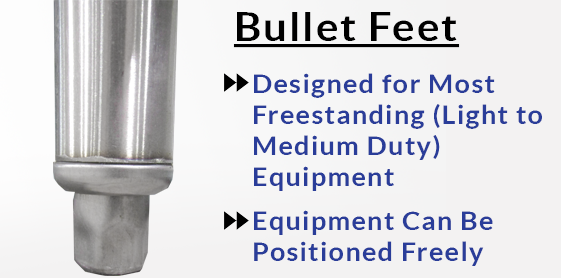
Bullet feet are tapered & rounded in shape, hence the name bullet. While flanged feet are targeted towards heavy duty equipment, bullet feet are useful for light to medium duty products that do not need to be bolted down. They are also height adjustable just as the flanged feet.
The biggest advantage is that it enables equipment to be repositioned with ease. Bullet feet also make the surrounding area easier to clean. The disadvantages are the potential scuffing of floors & less surface area distribution.
Which One is Better?
There is no one universal winner, so the choice will ultimately come down to whether you need your equipment to be mobile or permanently bolted down. Bullet feet offer more versatility, but it’s not suited for heavier duty equipment. Flanged feet offer a permanent position but can be a hassle if you need to relocate or clean the surrounding area.
Try to assess your layout before selecting the correct feet that will work for you. If you are still undecided, you can equip your product with both types if necessary.
Product Roll Call
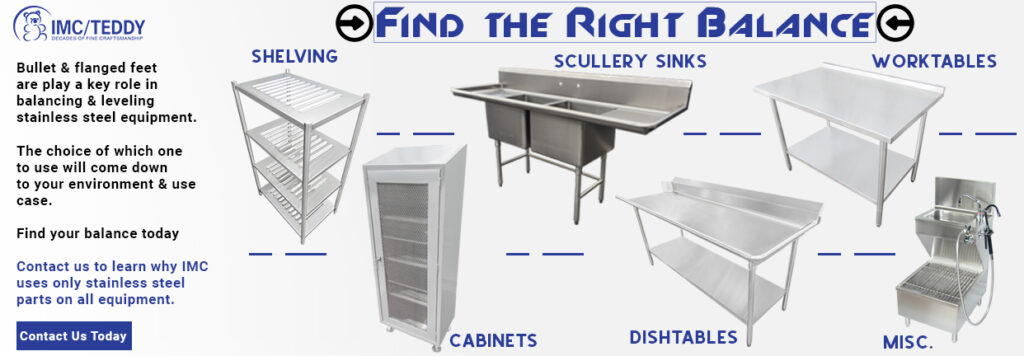
With the above explained, let’s go over some IMC products that can have bullet & flanged feet:
- Shelving
- Scullery Sinks
- Dishtables
- Worktables & Stands
- Cabinets (Except Wall Mounted)
- Misc. Freestanding Equipment such as Model #CMS or Benches (Model #BNC, Model #LSB)
On a side note, IMC only uses stainless steel bullet & flanged feet. No plastic pieces are ever used in our products.
Having a base that is durable, stable & reliable is vital. With the help of bullet & flanged feet, this can be achieved easily. For more information on how IMC products differ from the competition, click here.