
Galvanic Corrosion? What Is It?
The planet is full of unexplained & strange occurrences that have been studied for years. In the world of metal, one of them is called “galvanic corrosion.” Although the name might be foreign, you’ve probably witnessed this type of phenomena in your life without even realizing about it. Relevant to the foodservice industry, how does galvanic corrosion affect the safety & sanitation of a facility? We’re here with answers.
In this article, we’ll go over what galvanic corrosion really is & give some advice for dealing with it in a foodservice environment. Class is now in session.
Opposites Do Not Attract
Using a simple definition, galvanic corrosion occurs when two dissimilar metals are in contact with each other in an environment where moisture (or other solution) is present. The greater the difference in metals means the more likely the pairing will experience galvanic corrosion.
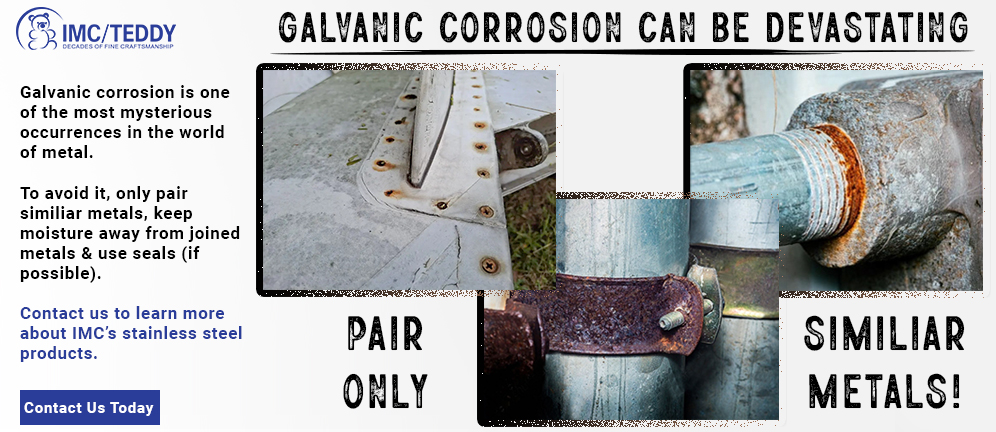
It is most common in screws, fittings & threadings where two dissimilar metals are paired, creating a haven for this phenomenon to occur. However, it can occur in other instances as well. Here’s an excellent example of galvanic corrosion in an outdoor environment.
Can Stainless Steel Experience This?
It certainly can, but the conditions are very particular. For one, stainless steel must be paired with a more active metal such as carbon steel or aluminum. Secondly, both metals will have to be subjected to intense moisture & humidity – almost nonstop for a long period of time.
With these two caveats in place, stainless steel structures have the potential to weaken. With that said, there are ways from keeping corrosion from happening.
How Can It Be Avoided?
Luckily, galvanic corrosion is easily averted. Here are the simplest ways of achieving this:
a. The most obvious way is to select compatible metals in your pairings when possible. Compatible metals are less likely to encounter galvanic corrosion. For stainless steel, an example of compatible metals include copper, titanium, brass & bronze.
b. Use a physical barrier to separate the metals. These barriers can be sleeves, gaskets or tapes with anti-corrosion properties.
c. Keep the metals dry & sealed. Although in most instances this might be impossible, there are coatings & paints that exist to insulate the metals. Indoor pairings are less likely to experience galvanic corrosion due to the lack of moisture, but humidity can still be a factor.
With these tips in mind, you will be 100% in the clear.
IMC/Teddy has been working with stainless steel for well over 70 years for food service applications. IMC lives & breathes stainless steel & our knowledge of the metal is vast. Our products are proudly made in the United States of America using Type 304 stainless steel. Type 304 Series stainless steel is proven to be the most useful material in the food service industry due to its strength, durability, & corrosion resistance. For a closer look at our mission, click here.